Forms of Buddhism
Many forms of Buddhism are actually
practiced around the world. Buddhists don’t all follow the same
teachings and the same texts. The core principles stay the same but
different important aspects are observed in each type. Each form is
also subdivided into schools.
The Three Main Forms
Theravada Buddhism
Mahayana Buddhism
Vajrayana Buddhism
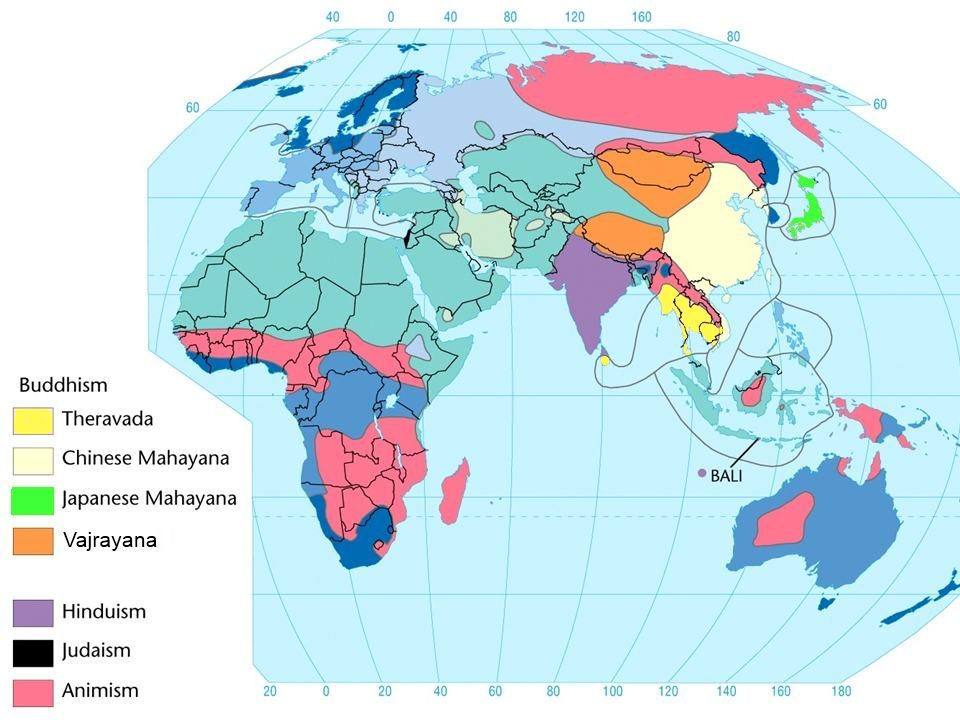
Map Of Buddhism in the World
Theravada Buddhism
Yellow on the map.
Theravada Buddhism is also known as the doctrine of the elders,
Southern Buddhism or Ancient Teaching. The main text used by this
school is the Pali Canon. The main area of influence includes the
following countries: Sri Lanka, Cambodia, Thailand, Laos and Burma
(Myanmar). They have about 100 million followers and are gaining ground
in Singapore, Vietnam and the Western world.
This form of Buddhism is characterized by its orthodoxy. They are
considered to be the closest to the teaching of Buddha and the text
they use- the Pali Canon- is the oldest surviving Buddhist text.
Their beliefs are that each individual can attain enlightenment by
himself and the best way to do this is by joining the monastic way of
life as it allows for an ideal setting to dedicate one’s life to the
Dharma. Lay people have a role to play also and it is partly comprised
of Merit Making actions including:
- offering food and other basic necessities to monks
- making donations to temples and monasteries
- burning incense or lighting candles before images of the Buddha
- chanting verses from the Pali Canon
- act as trustees or custodians for their temples
- taking part in the financial planning and management of the temple
- volunteer significant time in tending to the mundane needs of local monks
Monks gain merit by practicing mindfulness, meditation, and chanting.
In the Pali Sutra, the Buddha instructs the followers to follow
concentration as it is a tool he used to attain nirvana. Thus, the
Theravada Buddhist practice these form of meditation:
- Anapanasati
- Metta
- Kammatthāna
- Samatha
- Vipassana
Mahayana Buddhism
(Green and white on the map)
(Green and white on the map)
Mahāyāna is also called the Great Vehicle, Bodhisattvayāna or the
Bodhisattva Vehicle. It is the larger of the two major traditions of
Buddhism existing today, the other being that of the Theravāda school.
It is also the origin of the Vajrayana form.
It is mostly popular in China, Japan,
Korea, Vietnam, and Mongolia and spread very widely in the west. Major
traditions of Mahāyāna Buddhism today include Zen (Chán), Pure Land,
Tiantai,(Tendai in Japan) Nichiren, and Esoteric Buddhism (Shingon, Tibetan Buddhism (although we further separate them below)).
The beliefs: Mahayana Buddhism prones liberation of suffering for
all sentient beings. Where Theravada focuses on individual
enlightenment, Mahayana preaches that Buddhas and Bodhisattvas are here
to help us attain collective illumination.
Thus they believe in supernatural bodhisattvas who devote themselves
to the perfections, ultimate knowledge, and the liberation of all
sentient beings. The Buddha is seen as the ultimate, highest being,
present in all times, in all beings, and in all places, and the
bodhisattvas come to represent the universal ideal of altruistic
excellence.
It is difficult to talk about an unified canon for the Mahayana
tradition as it is often assimilated by local beliefs and traditions.
In Japan, it has incorporated some local Shinto beliefs and some
Shamanism. Thus, when observed under this angle, it becomes incorrect
to refer Buddhism as a non-religion in the Mahayana tradition because
of the gods that were later added and all the powers attributed to the
different Buddhas and Bodhisattvas.
Vajrayana Buddhism
Vajrayana is in fact part of the Mahayana school but because its
emphasis on tantrism, it is often cited as a different school. It is
also known as Tantric Buddhism, Tantrayāna, Lamaism, Mantrayāna, Secret
Mantra, Esoteric Buddhism and the Diamond Vehicle. It is mostly active
in Tibet and Japan, and in China, to some extent.
Vajrayana is a school of esoteric knowledge, secret rituals, mudras
and mantras. It teaches that in order to access esoteric knowledge, the
practitioner requires initiation from a skilled spiritual teacher or
guru.
Rituals are an important part of the Vajrayana Buddhism. They
substitute meditation as they are focused and with purpose. Esoteric
Buddhism is often associated with magic as many of their rituals entail
working with the supernatural, manipulating the laws of nature with the
help of the entities of the Buddhist pantheon.
In this form of Buddhism, like in Mahayana, the ultimate goal of the
practitioner is to become a Buddha. Vajrayana teaches that the
Vajrayana techniques provide an accelerated path to Buddhahood. But,
Reginald Ray writes that “If these techniques are not practiced
properly, practitioners may harm themselves physically and mentally. In
order to avoid these dangers, the practice is kept “secret” outside the
teacher/student relationship. Secrecy and the commitment of the student
to the vajra guru are aspects of the samaya , or “sacred bond”, that
protects both the practitioner and the integrity of the teachings.”
It is then difficult for westerners to study this path as it often
entails speaking the language (ibetan and Japanese) and being accepted
in a monastery by a master. In Japan, in particular, Koya-san
accepts some foreigners but the path is difficult and they often suffer
from some form of subtle racism as the Japanese people feel that
Buddhism can only be understood by Japanese.
|
Return from 3 Forms of Buddhism to Principles of Buddhism |


New! Comments
Have your say about what you just read! Leave me a comment in the box below.