Zenkoji

In the beautiful city of Nagano, you can find Zenkoji. It
is very well situated in a valley surrounded by the Japanese
Alps. This temple is square in the center of the city as Nagano-city
has been built around it.

Nagano City
 Zenkoji is one of the
few remaining pilgrimage temples in Japan. Not as famous as the
88 Kannon temples of Shikoku but renowned enough that each year, more
than 7 million people visit the temple complex, many foreign visitors
among them.
Zenkoji is unique in many ways but one of them is the fact that it does
not belong to any one sect. Usually temples in Japan are built by
a Buddhist sect an they stay in the sect for senturies or sometimes
change ownership for various reasons. Well Zenkoji does not
belong to one sect but it is being managed conjointly by both the
Tendai sect and the Jodoshu
sect.
Another unique aspect of Zenkoji is that the temple shelters the oldest
Buddhist image in Japan. Its story dates back from the 600s so
the temple is more than 1400 years old.
Zenkoji’s History
 Zenkoji was built in
the 7th century after Yoshimitsu Honda rescued the first ever image
brought to Japan from the waters of the Naniwa no Horie canal.
That Buddhist image, the first ever in Japan was brought in 522AD, from
the Kingdom of Kudara in Korea. It is called the Ikko Sanzon, or the
Amida Tathagata statue.
That statue was thrown in a river, as I said above, due to some
warring factions who didn’t agree if Japan should adopt Buddhism or
not. You
can read more about the history of Buddhism in Japan on this page.
Yoshimitsu Honda, from the province of Shinano (modern day Nagano)
rescued the statue and enshrined it in his house, in the city of
Nagano. This bacame the first Zenko-ji, who’s name come from and
different reading of his first name Yoshimitsu (善光)
In Japanese, most
characters have more than one reading. For example, 車, car, can
be read kuruma or sha. We will choose the reading according to
context and the characters surrounding it.
 The story of that
statue has since been quite eventful. It soon became a
hibutsu, or secret Buddha, and it is perpetually kept hidden from the
public eye.
It is called the “Ikko Sanzon Amida Nyorai”
and is classified as an Amida triad.
It is wrapped like a mummy and stored in a box behind the main altar.
The rules of the temple require the absolute secrecy of the statue,
prohibiting it from being shown to anyone, including the chief priest
of the temple.
Through the years, is has been seen by a few people, in 1720, in
order to quell rumors that the box was empty, the Tokugawa shogun
ordered a priest to confirm its existence.
That priest, remains the last confirmed person to have seen the statue.
Some replica of the statue, called Zenritsu Honzon, has been made which
may be shown publicly once every six or seven years, in a ceremony
called Gokaichō. The most recent display of this copy of the Hibutsu
took place in 2009.
Some other copies of the statue were made and brought to other temples
around Japan. these temples are called Zenko-ji or even
Shinzenkoji (shin means new).
One such temple is in Kai Zenkoji, in Yamanashi prefecture.
Takeda Shingen, a warlord ruling over the Nagano area in the 16th
century was often battling out Uesugi Kenshin. Fearing to lose
the treasures in the temple by the fire of battles, he moved everything
from Nagano to Itagaki in Yamanashi.
The things moved to Yamanashi include the hibitsu, some statues and
treasures of Zenkoji.
Itagaki is where Honda Yoshimitsu, the founder of the Zenkoji temple,
was buried so there was still a connection with the founder of the
temple.  Takeda Shingen battling with Uesugi Kenshin.
Other such temples appeared through the years and the treasures have
been moved a few times; Toyotomi Hideyoshi (1536-1598) moved the
hibitsu to the capital city of Kyoto, and then to Shinano, before it
was returned to Nagano. 
Finally, during the Tokugawa Shogunate (1603-1868) it was decreed that
the temple be moved to its present location. And the current buildings
were built.
The main hall dates from 1707 and is 30 meters in height, 24 meters in
width, and 54 meters in depth, making it one of the largest wooden
buildings in all of Japan.
Visiting Zenkoji

Going to Zenkoji is quite easy. First, Nagano city is connected
with Tokyo by shinkansen and it takes only 1 hour and 40 minutes to get
there. It is easily doable in a day trip.
From the station, you could take a public bus (100yen per adult) (well identified in English) or walk to the temple. It is about 20 minutes on foot to get there.
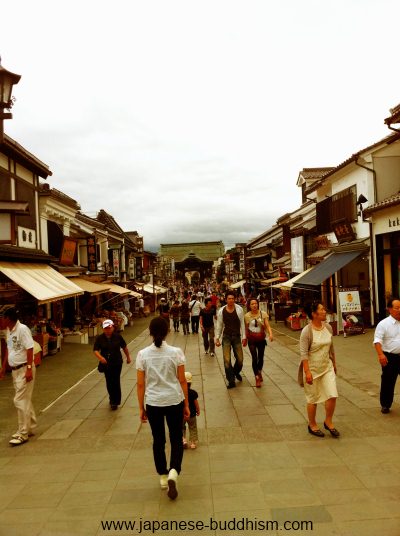 You will, most probably
arrive through the main street, filled with merchants on both
sides. This is interesting to sample some local delicacies and
look at the temple merchants sell. They mostly all sell the same
trinkets: wooden swords, key chains and Japanese pottery. You
might find a few interesting items there, especially if you are a
tourist looking for souvenirs.
You will, most probably
arrive through the main street, filled with merchants on both
sides. This is interesting to sample some local delicacies and
look at the temple merchants sell. They mostly all sell the same
trinkets: wooden swords, key chains and Japanese pottery. You
might find a few interesting items there, especially if you are a
tourist looking for souvenirs.
Be aware though that the price will vary from shop to shop and the goods are usually the same all over so be sure to look around. I recommend the grilled mochi shop on the left hand side. It's simply delicious.
On the left hand side, shortly before the main gate of Zenkoji, you
will see an open building with a bronze cow in it.
Pilgrims will rub the cow for good luck.

A Japanese proverb says "Led by an ox to Zenkoji." It means a
person is led to a good situation by chance even though he/she does not
act on his/ her own will but act at someone else's invitation.
The story is that an old woman, who was not a believer but lived near
Zenkoji saw a wild ox catch a piece of cloth from her garden in its
horn. She ran after it but the ox fled all the way to
Zenkoji. After what she heard and saw there, she became a
believer and a regular visitor to the temple.
The Main Gate

You can see me here, posing in front of the main gate of Zenkoji,
called the Sanmon. When I went there in September of 2011, you
could go inside the gate to visit an exhibition of five wooden Buddhist
statues that are not usually open to public. The price was 500
yen and you cannot take pictures.
This gate is classified as an important cultural asset and there is a
plaque reading "Zenkoji" in Chinese character at the top. This
plaque has been written by an imperial prince and it is said to contain
5 doves hidden in the calligraphy.
Zenkoji Hondo's main plaza

The main hall
The main hall of Zenkoji is designated a national treasure.
It was finished building in 1707 by the Shogun and it shelters the
hibutsu.
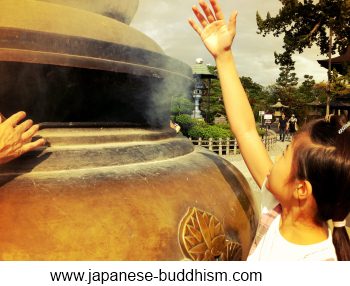 Before getting to the
main hall, though, you arrive in the main plaza where you will find a
huge incense burner. Every morning, the Jodo shu Abbotess will
light it and pilgrims will rub the smoke on themselves to gain good
fortune or health.
Before getting to the
main hall, though, you arrive in the main plaza where you will find a
huge incense burner. Every morning, the Jodo shu Abbotess will
light it and pilgrims will rub the smoke on themselves to gain good
fortune or health.
 Also, bording the
plaza, you will find several statues and artefacts. Some of these
statues are the 6 Jizos.
Also, bording the
plaza, you will find several statues and artefacts. Some of these
statues are the 6 Jizos.
The Rokujizo (roku means six in Japanese) are to the right of the
Tendai sect's monastery. They represent six Boddhisattvas who
gave up enlightenment in order to provide help to all sentient
beings. They are said to be able to commune with all six realms
of hell: starvation, beasts, carnage, human beings and divine beings.

Here is the same plaza, taken from the balcony of the main hall. It was January 1st, 2011. As you can see there is quite a crowd to pray. It's a tradition in Japan to visit temples and shrines on the new year to pray for the coming year. Since Zenkoji is such a popular temple, crowds come to pray here.
Zenkoji's main hall

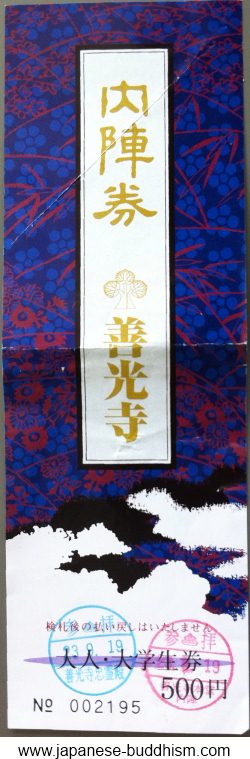 To enter the main hall
is free but if you want to pass beyond the gate and follow the
authorized course (the blue arrow in the above picture) you need to get
a 500 yen ticket. That ticket will give you access to two more
sites in the temple complex.
To enter the main hall
is free but if you want to pass beyond the gate and follow the
authorized course (the blue arrow in the above picture) you need to get
a 500 yen ticket. That ticket will give you access to two more
sites in the temple complex.
Let's start by explaining what lies beyond the public area and then we can get back to the free area.
As you pass the gate, you have to remove your shoes and a plastic bag will be provided to carry them with you as you go and visit the hall.
Immediately to your left, there is a large worship area, facing the compound sheltering the main Buddhist image. You can not see the statues but there is a place where you can offer zuko, a kind of powdered incense and offer a quiet prayer. The room is laid with tatami mats so it's comfortable and you can sit on the floor.
At the time of my visit, a Shodo-shu monk was at hand to answer a few questions. Actually he came forward and asked us if we spoke English. He then offered instructions in English!
In the morning around 6 am you can assist to a morning service. (it is actually 1 minute later everyday starting in November.) During that service they show the replicas of the main altar and its secret image.
Just past that main area, to the right, there is a staircase leading down. That staircase and the hallway beyond is pitch black. You are instructed to hold your shoes in your left hand and follow the wall with the right one. Eventually, at the end, people touch a iron handle called a key. By finding it in the dark, one gains salvation.
It's mostly a tourist trap (Do I really get salvation by finding a iron handle in the dark?) but I think it is symbolic of Buddhism. In the dark of the illusions of this world, by following the Buddhist precepts (the wall) one can attain salvation.
That's all there is to do beyond that point, the other areas are not open to the public.
Let's go back to the free area.

The first thing you will notice when entering the hall is its
size.
It's one of the biggest wooden structures in Japan (the temple
sheltering the great Buddha of Nara is the biggest).
Directly in front of you, if you enter on the right side f the hall will be Saint Binzuru. He was a doctor who became a follower of Buddha. People touch him on the area they want healed. For this reasons, the statues of Binzuru in temples around Japan (there is one in Nara too) are always rubbed to a shine and are worn. This one was replaced in 2009 because it was too badly damaged.
 Here, you will also find
some drums used for ceremonies and
Here, you will also find
some drums used for ceremonies and
a souvenir shop. You can buy some worship items like prayer
beads, books, charms etc. To the right of the building, you have
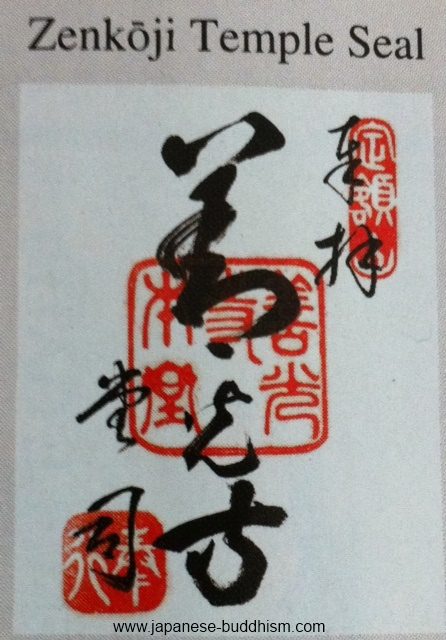
the temple seal area, if you collect those (many pilgrims will carry a
book where they collect the seals of the temples they visit.)
You will also find a statue representing Emma, the judge of the dead and the caretaker's office.
The rest of the Zenkoji compound
The compound has several other buildings, like the scroll repository, the different residences, etc. but most are not open to the public. Another building you can visit is War Dead Memorial.
 This pavilion shelters the ashes of thousands or
people who died during the war. It is not as famous as the
Yasukuni shrine in Tokyo (each year there is a huge controversy when
the prime minister visit this shrine which is said to also
contain the ashes of war criminals and China and Korea, in particular
also protest the visit.)
This pavilion shelters the ashes of thousands or
people who died during the war. It is not as famous as the
Yasukuni shrine in Tokyo (each year there is a huge controversy when
the prime minister visit this shrine which is said to also
contain the ashes of war criminals and China and Korea, in particular
also protest the visit.)
I don't know if the ashes of war criminals are contained here but they are not open to the public anyway. What is of interest to us is the museum in the basement of this building. The 500 yen ticket you purchased in the main hall will give you access to this museum.
There is a lecture hall for groups, a TV with videos on the temple and
a neat collection of Buddhist art in this museum.

Unfortunately, there is no English explanation of the different pieces
but there is a guide tour in English and Chinese available on week-ends
and national holidays, from 10:00 to 15:00. If you are
interested, you can go to the main office and request a tour
guide. It's free and provided by volunteers so a token of
appreciation will be welcome.
The guided tour is available on reservation only. I will meet you
at Nagano Station and take you around town. We will visit the
temple and other interesting sites in the city. By filling the
form above, you will allow me to get in touch with you and we will
prepare a tour corresponding to your interests with you.
My fees are 10,000 yen for the day plus expenses to enter the different
sites. If the number of people is less than 3, I can provide
transportation from the station to the different sites with my private
car.
|
Return |


New! Comments
Have your say about what you just read! Leave me a comment in the box below.